


The biggest divide in AI isn’t between optimists and pessimists—it’s between those who understand it and those who don’t. Fear, doubt, and a sense of irrelevance are keeping too many people on the sidelines. But AI isn’t an unstoppable force for good or evil—it’s a tool. And if we want to have a say in how it shapes our world, we need to close the AI literacy gap before it closes opportunities for us.
[The audio version is AI-generated using NotebookLM].
Let’s take a step back.
We have a problem.
We live in a world where people are split into AI-optimists and AI-pessimists, instead of a world where we are united around the importance of AI literacy.
For example, if I mention the word “robot” do you think of “The Terminator” or “Wall-e”?
If you get asked at work to use a new AI technology* being rolled out, is your instinctive initial thought “I will lose my job” or “These tools are useless”?
Chances are that your mind goes to one extreme or the other. A bit like this Dall-e image!

Source: Dall-e
Asking the wrong question
Over the past year, I’ve had the opportunity to speak to people from diverse backgrounds while building my own business. A common thread emerged: When I speak to technologists, they believe that AI will solve our world’s greatest problems. They see it as a panacea. In Greek mythology, Panacea was the goddess of universal remedy and healing.
Consider the associated headlines: “An inside look at AI’s potential to achieve the SDGs” says Devex. “AI versus cancer”: the Cambridge researchers using machine intelligence to beat disease. AI crucial to tackling environmental challenges, say experts at Turing and Met Office event. Forbes says: “5 Ways To Harness AI And End Poverty Forever.” The message is one: AI will help us solve wicked problems: those complex, multidimensional challenges that we have struggled to address so far.
Yet, outside of the tech world, among the greater majority of people I speak to, AI is either seen as a threat to jobs or dismissed as overhyped. This fear or misunderstanding poses a risk that we will miss out on the opportunity that AI can bring to our world.
As Frank Herbert wrote in Dune, “Fear is the mind-killer.” It clouds judgment, stifles innovation, and prevents us from seeing AI for what it really is: not an unstoppable force for good or evil, but a tool we need to—and can—learn to wield wisely.
At some point in the exchange, the person I’m speaking with will inevitably turn to me and ask “What do you think? Are you optimistic or pessimistic about the future of AI?”
My belief is that this is the wrong issue to focus on, the wrong question to ask in the first place. We should not be divided into AI-optimists and AI-pessimists. The real issue at stake is whether we are sufficiently knowledgeable about AI to be empowered to shape our future.
The evidence suggests that we are not sufficiently knowledgeable, and in fact, an AI literacy gap is looming.
US-based research found that only 30% of respondents can correctly identify common uses of AI, and 44% do not believe that they interact with AI regularly (both are indicators of awareness). Worryingly, gaps widen among underrepresented communities. Only 15% of Black and 23% of Hispanic Americans have a high level of awareness of AI in their daily lives (compared to 34% and 40% for White and Asian Americans), according to the same research.
Other indicators tell a similar story. A study by the Reuters Institute at the University of Oxford examined public awareness and use of generative AI across six countries. In Argentina 59% of those they asked had never heard of ChatGPT.
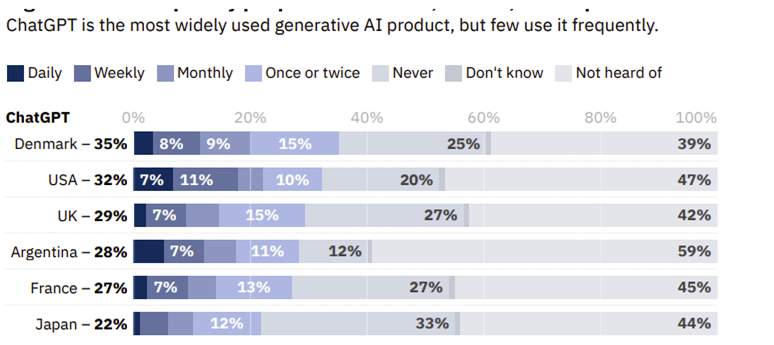
Source: Reuters Institute
Some promising steps are underway. But grand scale announcements are not sufficient to close the gap given how quickly the pace of AI technology is evolving. For example, in March 2024 the IndiaAI mission was announced. This includes a FutureSkills program, which will focus on expanding the reach of AI education by increasing the accessibility of graduate and post-graduate AI programs, while also establishing Data and AI Labs that will not just be spread across major Indian cities but also smaller towns and cities to impart foundational-level courses in Data and AI.
What are some of the factors driving the AI literacy gap?
Factor 1: Fear.
Many people fear AI. In a YouGov public opinion poll conducted in the US at the start of 2024, the predominant feelings reported in association with AI were negative or fear-related.
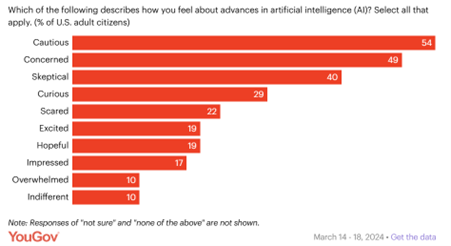
And fear is not unfounded. Humans are biologically programmed to fear change, and arguably it is what has driven the survival of our species, so far. Our amygdala are exceptionally good at detecting changes in our environment and flooding our body with hormones that enable us to respond, whether that is fight or flight. So it is unsurprising that we may fear AI, as it portends significant change ahead and a change that we do not yet understand and are not prepared for.
Factor 2: Doubt.
The second factor driving an AI literacy gap is doubt about its potential.
Some people believe AI is just hype and they just don’t need to worry about it. Just another fad, a bit like the metaverse, that will pass. In November 2024 I was in a leaders workshop, with people across the public, private and non-profit sector. One of the questions I got was “Are the use cases there? Is AI really having an impact?”
This is justified given the constant barrage of hyperbolic claims we see in the headlines, where a natural response might be doubt. Jeffrey Funk, is a retired professor, now an independent consultant, who calls himself “an AI hype buster”. Ha believes the potential of LLMs, like OpenAI's ChatGPT, is overhyped, and this is one of the themes in his book released in 2024: Unicorns, Hype and Bubbles: A Guide to Spotting, Avoiding, and Exploiting Investment Bubbles in Tech. In response to this I would highlight some data points. For example, while sales of VR headsets remain sluggish, ChatGPT was the fastest growing app of all time, reaching 100 million users within 2 months.
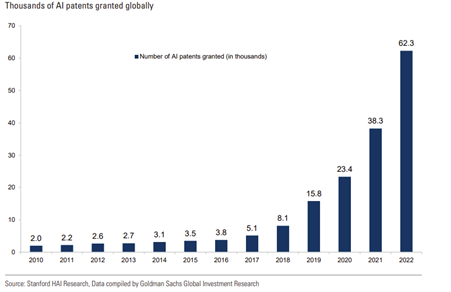
We’re also seeing a rapid acceleration in AI innovation and intellectual property development. By 2022, the number of AI patents granted globally skyrocketed to over 60,000, according to research by Stanford’s Institute for Human Centred Artificial Intelligence (chart compiled by Goldman Sachs).
Factor 3: Irrelevance.
Others believe AI is not relevant to them. Some dismiss it as futuristic or unlikely. Yet if history has taught us anything is that profound changes are the accumulation of a series of small steps. The adoption of AI in our world will not be “an event”. It will be a series of mundane changes made by companies that will change our future.
All of these three factors—fear, doubt and irrelevance—come together to exacerbate the gap between technological innovation and our response as a society. The pace of technological innovation is outstripping our ability to make sense of it, and master it.
Others believe AI is not relevant to them. Some dismiss it as futuristic or unlikely. Yet if history has taught us anything is that profound changes are the accumulation of a series of small steps.
The adoption of AI in our world will not be “an event”.
It will be a series of mundane changes made by companies that will change our future.
Next week The Athenian Intelligence will analyse why AI literacy matters for the future of our economies, societies and everyday lives.
[**Side note: AI is an umbrella term for a group of interrelated technologies. The National AI Strategy published in September 2021 describes AI as "machines that perform tasks normally performed by human intelligence, especially when the machines learn from data how to do those tasks". In general, AI behaves in a way that mimics some human cognitive processes, using data to inform decisions. While the field of AI continues to develop rapidly, it has already become a part of our daily lives.]

