

While writing a book on AI and leadership, I nearly included statistics that didn’t exist. Overwhelmed by the amount of information I had to manage when I first started, hundreds of podcast transcripts, articles, academic studies and datasets, I turned to Claude for help. I set up a research assistant. Generative AI systems are probabilistic and therefore hallucinations are an inherent problem. Yet the appetite to find a simple and fast solution blinded me to that.
I know every data point has to be verified, accurately represented, and from a high-quality source. (Sorry, Reddit.) It was something drilled into me both during my studies and when I first started working. And yet, after fifteen years of research experience, being sceptical and thoughtful about my sources, I was fooled by Claude.
This can happen to anyone.
And it’s the smaller version of a much bigger story: what AI is doing to truth, and trust, at work. Three challenges. Three small things you can do about them tomorrow morning.
I shared this earlier today at The New Normal, a community Paul Armstrong has built, on a panel with Susan Walsh (The Classification Guru) and James Ball (Pulitzer-winning investigative journalist and author).
Many people in the audience said they found it useful, so I’m sharing it here too. Do check Susan, James and Paul out, they’re worth your time.

THE FUTURE OF TRUTH
We all gathered at the event to talk about the future of truth.
Yet we have no common understanding of what TRUTH actually is.
Is it facts? Is it beliefs? Or something else entirely? And why does it even matter for success in the world of work?
Before we get to the future of truth we need to look to the past.
In ancient Greece, the philosopher Parmenides, writing around 500 BC, used the word aletheia. Literally translated, aletheia means not concealing. Revealing. Bringing into the open. For Parmenides and the Greeks who came after him, truth was something that came out of hiding. It was about disclosure.
Fast forward a thousand years and you find a very different idea. By the time we get to the medieval times, truth has become something more like faithfulness: being faithful to your beliefs, to your word, to a doctrine, to a sovereign.
And now skip forward again to 2016, when Oxford Dictionaries declared the word of the year to be “post-truth”. Use of the word had jumped 2,000% in twelve months. Oxford defined it as a state in which objective facts matter less than appeals to emotion and personal belief.
Two things are clear from this brief history scan:
1. That the very notion of truth has evolved over time. We don’t have a shared definition of what truth is. It could be about accuracy and “facts”. It could be about authenticity. Or it could be about being transparent and not hiding anything.
2. We might not have a shared notion of truth but what we DO SHARE is a belief that it matters to us. The sheer weight of resources, time and thinking that humanity has poured into asking that question across philosophy, science, religion and law is itself the evidence of how much we care about it.
We care about it because truthfulness is what allows us to build trust over time – which is the fundamental building block of our relationships. Trust is what allows us to succeed at work, with each other, in our lives.
When truthfulness goes, so does trust.
TRUTH MATTERS FOR TRUST AND TRUST MATTERS FOR SUCCESS AT WORK.
Look at what happens when trust breaks down and the productivity impact.
The Edelman Trust Barometer is an annual survey of trust that has been going for 25 years. They survey 30,000 people across 28 countries. In their most recent survey they looked at the crisis of trust and what that looks like in the workplace.
Think about this:
42% said they would rather switch departments than report to a manager with different values.
A third would put less effort into helping a team leader who held different political beliefs. That’s the productivity impact.
TRUTH AT WORK
When we say “truth” at work, we usually mean one of three different things:
1. Truth = accuracy. Does the output match the facts? Is the data right?
2. Truth = sincerity. Does the person mean what they say? Are they standing behind it?
3. Truth = transparency. Can I see where this came from? Can I trace it back?
Now enter AI.
As AI enters the workplace it alters how truth and trust are built and maintained. And it’s bringing a new set of challenges.
1. Truth ≠ accuracy
AI challenges the relationship between truth and accuracy.
It does this through hallucinations and workslop.
Not all AI is the same but generative AI is famous for its hallucinations. This matters for accuracy and for the quality of our work.
Last October, Deloitte Australia had to refund the Australian government after delivering a A$440,000 report on the country’s welfare-penalties system. The report contained multiple fabricated citations to books and papers that didn’t exist. The irony - Deloitte announced the refund the same day it announced a global partnership to roll out Claude to its half-a-million employees.
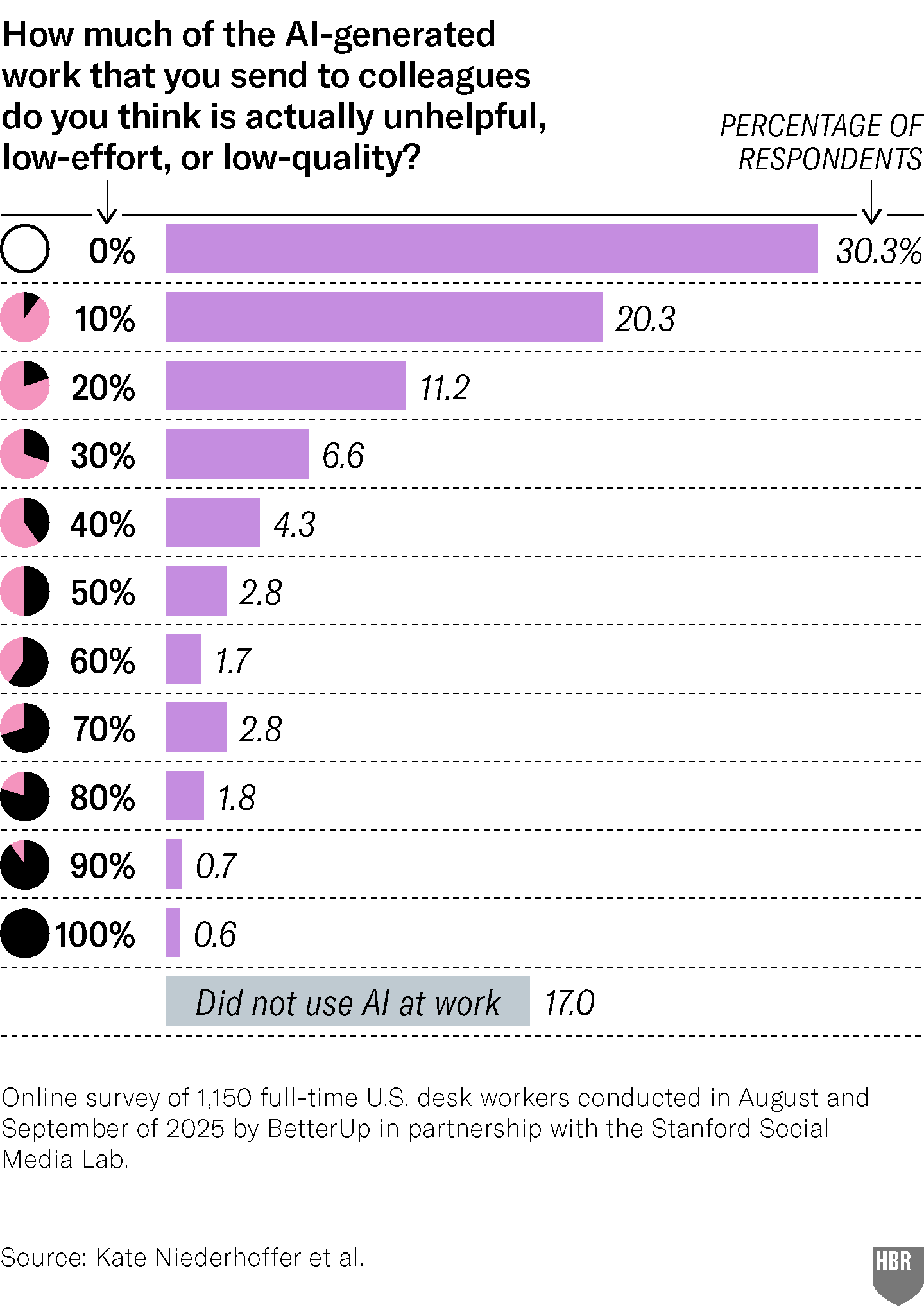
And then there is workslop - which unfortunately we’re all becoming more familiar with.
Our baseline assumption is that we send our best-quality work to our colleagues. Yet, more than half of us now admit to sending AI-generated content that we haven’t reviewed.
If that quality baseline collapses, how do we know what's real?
2. Truth ≠ sincerity
AI challenges the relationship between truth and sincerity.
Early in my career I worked as an economist for ArcelorMittal, in their shipping division. The first thing I learnt was the phrase “my word is my bond.” This is not just a saying. It governs how the Baltic Exchange, the world’s oldest shipping market, has functioned for centuries.
Historically most negotiations between brokers and charterers were done initially in person at Lloyd’s coffee house, and more recently by phone, before being put in writing. If your paper trail did not match what you had verbally agreed, your reputation in the market - and your ability to do business - was undermined.
I think about this example precisely because shipping is not an industry known for leading on AI adoption. Yet it relied on a trust mechanism that allowed complex, high-value transactions to move quickly. My point is not that older industries “did trust better” but that trust used to be designed into everyday work through visible interactions. AI in our workplaces removes many of the signals that once enabled trust.
The other angle that matters here is how management is perceived. A study last August by the University of Florida and USC asked employees to rate managers’ messages. When the manager used minimal AI assistance, 83% of employees rated them sincere. When the manager used heavy AI assistance, that dropped to 40-52%.
This has important implications for anyone that manages other people.
3. Truth ≠ transparency
The third way that AI is challenging truth in the workplace is transparency.
At work - and especially for regulated industries - we expect that our colleagues are able to show us how they arrived at their output and that traceability element is essential.
It turns out that AI is making it harder to do that because we won’t admit to it.
A KPMG study of 48,000 employees found that 53% present AI-generated content as their own.
What is happening here is our emotions are coming into play.
Some people fear being seen as less competent if they had to use AI to deliver their work.
Others see it as a threat to their identity – if they’re known for a particular expertise then admitting to AI usage threatens that.
For another group of people it might be simply not knowing what the rules of the game are because companies haven’t figured out the governance yet.
There are two sides to this and this is where it gets a bit trickier. The challenge of non-disclosure so far comes from us as humans and our emotional responses. But it also comes from the evolution of the technology itself.
Right now we’re debating disclosure as if AI is something you pick up and put down. But AI is becoming a feature, not a product. It’s already in our search, our meeting summaries and our spreadsheets. At some point the question “did you use AI for this?” becomes like asking “did you use spell-check?”
WHAT NOW?
We have seen how AI is challenging the relationship between truth and accuracy, truth and sincerity and truth and transparency.
AI is a powerful set of technologies but it’s the way that we use it that will shape the future of work.
What I thought would be helpful is to share with you some of the emerging findings from the research for my forthcoming book “AI:Q the new leadership imperative for the Human+AI era” – and it is based on 200 senior leaders taking the AI-Q diagnostic and 50 interviews.
Here are three of the areas where high AI-Q leaders are different from the rest, and what we can learn from it.
PROTECT YOUR THINKING
Critical thinking kept emerging as one of the defining capabilities for leadership in the AI era. Not as a personality trait but as a discipline. The willingness to be the friction. The muscle to slow down when everything around you is engineered to speed up.
Here is what I’d ask you to do.
Build a verification habit before you build an AI habit. For every output that will leave your desk under your name, ask these questions:
Does this make sense?
Where did it come from?
What’s missing?
What biases and assumptions are baked in?
Your most important contribution in the AI era is not using AI faster than your colleagues. It is being the person in the room who interrogates what it produces.
“KNOW” PEOPLE
Building relationships with others will increasingly be what you uniquely bring to the workplace.
Two specific actions.
First, have the conversation with your team about what AI means for their roles. One of the questions I asked in the survey was for leaders to rate their confidence in leading their teams through AI-driven change. Yet almost a quarter of leaders who described themselves as confident had not actually had a conversation with their teams about that very change.
Second, align with your peers on what counts as a win. The same AI initiative looks like a success to one function and a failure to another. Get explicit about what matters before you measure outcomes, not after. This emerged as one of the key reasons why some companies are struggling to capture the ROI of their AI investments and it’s not showing up in their metrics.
One story I came across that I thought really showed the power of relationships and how they’re becoming even more important was that of Ferrari. In July 2024, an executive at Ferrari received WhatsApp messages and a phone call. The voice on the other end was the CEO Benedetto Vigna’s perfectly cloned, southern-Italian accent intact. The “CEO” needed help rushing a confidential currency-hedge transaction.
The executive asked one question: “What was the title of the book you lent me last week?”
The scammer hung up and Ferrari avoided a costly scam.
FIND YOUR RED LINES
Decide where you will use AI and where you will not. Be deliberate, write it down, and communicate it to the teams you work with.
A practical exercise. Sort your work into three categories.
Where you will use AI freely.
Where you will use AI but always review personally.
Where you will not use AI at all.
Then share that list with your team this quarter, so they know how to read the work that comes out under your name.
The CEO of a global publishing house told me he had worked with his marketing team to train an AI agent to write speeches and emails in his voice and tone. But he never let the agent or the team send anything out without personally editing every line. His red line was simple: nothing goes out under his name without his sign-off. Authenticity of voice was non-negotiable, even when AI could replicate it.
When I looked at the practices distinguishing high AI-Q leaders from the rest, this was the single biggest behavioural gap. Not who used AI most but who had decided most clearly where they would not use it.
We started off with a brief history of truth. But the future of truth is still being written, today, by you and me and the actions we take. Every small action holds power.
"Can they" - yes, especially if they see the link to trust and relationships with their customers and employees.
"Should they" - yes, if they want to be responsible citizens.
But on the question of
"Do they" - no, experience tells us they don't do this enough.
Going big here, I like it. Not sure where our work fits under the “truth” umbrella…can corporations be concerned with Truth?