

Why do some leaders seem to get returns from AI, while others, who are often better-resourced, stall?
What is that magic sauce?
This is the question that I kept coming back to during the research for my forthcoming book AI-Q.
What I discovered was that it wasn’t technical skill, nor budget. It wasn’t even how early they’d started. Those getting measurable value from AI shared something else: a particular way of thinking, particular human abilities, and a particular set of day-to-day practices, that together shape everything about how they engage with AI.
These patterns underpin AI-Q.
They also show up in the results. Data from around 200 senior leaders who took the full AI-Q diagnostic found that high AI-Q leaders were three times as likely to report a quantified business outcome from AI in the last twelve months. That held after controlling for role, organization size and how mature their organization was on AI.
Defining AI-Q
First let’s take a step back. This is how I define AI-Q:
AI-Q is the degree of leadership readiness required to create value in a world where human and machine intelligence work together.
It is built across three interdependent dimensions: Mindset, Abilities, and Practices (MAP):
1. Mindsets reflect how you think about AI and your role as a leader in relation to it.
2. Abilities are the human capabilities that make your leadership effective in an AI-enabled world. Across my research, five consistently emerged as differentiators: critical thinking, empathy, strategic thinking, creativity, and learning agility.
3. Practices are the concrete actions through which mindsets and abilities show up in your approach to AI. They are the ways of working that embed AI-Q into everyday leadership.
If mindset shapes how you think about AI, and abilities shape how you work with it, practices shape what you do.
Why Mindset is the starting point for AI-Q
Mindset shapes how you instinctively orient toward AI before you do anything else.
Every leader I interviewed who was getting value from AI described a mindset shift first, before any change in skills or tools.
Abilities only deliver value if you have the mindset to recognize where they apply.
Three mindsets in particular distinguished leaders who translated AI capability into value.
A growth mindset of treating AI readiness as a capability to be developed rather than innate talent.
A systems mindset of understanding how changes in one area ripple through the organization.
A foresight mindset of anticipating how AI reshapes industries and roles, and the external operating environment.
Together they form the foundation of individual AI-Q.
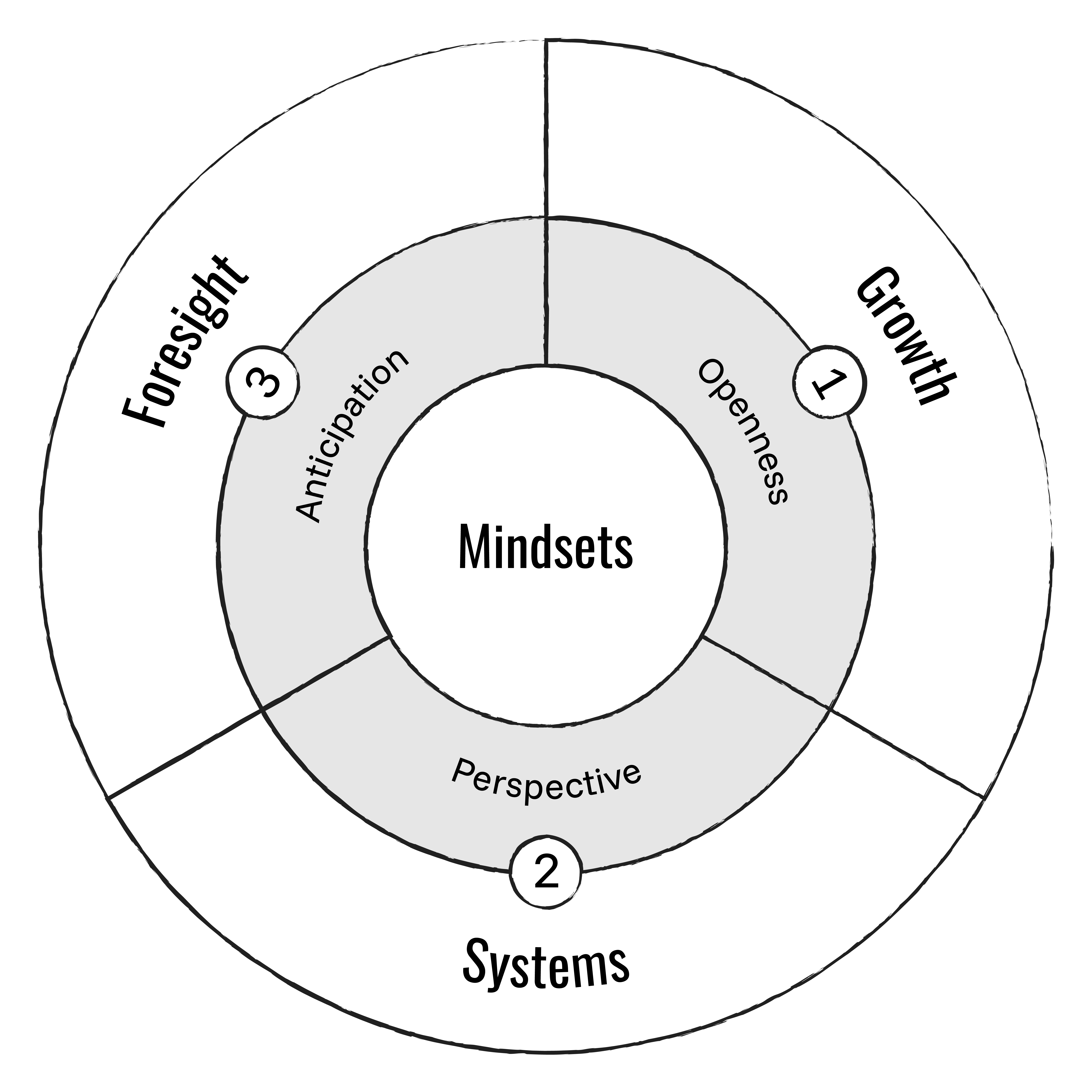
What do these mindsets look like in practice?
1. Growth: “this is not my area, yet”
Growth mindset is the belief that capabilities can be developed through effort, including the capability to work with an unfamiliar and fast-moving technology.
Take Panos. He is a Risk Director at a global investment bank, where he frequently reports on the bank’s current risk exposure from different trades and positions held in financial markets. We met at the start of our careers when I was an economist at the Association of British Insurers and he was a risk analyst at Barclays.
He has spent twenty years building deep expertise in risk reporting.
He told me that he had initially assumed AI was for the data scientists in his team. Then he decided to teach himself.
I asked him what motivated the change of heart.
“I wanted to focus on higher value-add tasks: examining data, critiquing it and giving strategic advice rather than preparing repetitive reports.”
Within three months, the eight hours per month that he spent extracting data and creating PowerPoint presentations had been redirected to those strategic activities.
2.Systems mindset: “see the whole to redesign it”
A systems mindset is seeing how the individual parts connect to each other and to a larger whole.
This is becoming essential as AI agents become more prevalent at work. It is tempting to think of AI agents as hiring more staff, only faster and cheaper. But AI does not simply add capacity. It changes the structure of the system itself.
You are no longer managing a team of people. You are managing a team of people who are each managing agents. What looks like a team of five can quickly become a much more complex system involving dozens of interacting components.
Mike Jones, the CTO of loveholidays, describes systems thinking as the ability to step back from individual tasks and see the whole end-to-end process that produces an outcome. He is a big proponent of drawing a system to understand it.
I asked him why it matters so much for AI.
“Once you can see the system, you can redesign it.”
Now think about where most AI pilots happen. In one department, on one process, with one team.
AI adoption is about driving outcomes across the business, not in a particular function. High AI-Q leaders apply a systems mindset to create coordination and cooperation across departments, so they can drive change across their organization.
3.Foresight mindset: “avoid the tyranny of the urgent”
AI is making the future more uncertain than ever. A foresight mindset helps you anticipate change systematically. It treats the future as part of the job of leadership today, not an offsite luxury.
Leaders know, in theory, that they should look ahead. In practice, they spend most of their time in firefighting mode.
As a junior consultant at Accenture, I remember one of my managers, Paul Nunes, talking about “the tyranny of the urgent” in business. Paul has spent decades researching what sets leading companies apart. In his book Big Bang Disruption, he shows how for many leaders, by the time disruption feels urgent, the window to respond has already narrowed.
AI intensifies this. Competitive dynamics can shift quickly, and from unexpected directions.
I saw what this looks like at a roundtable with heads of research across consulting, legal and finance firms. One of them put it like this:
“AI can spit out data and answers, but what we truly need is people that can apply data to our specific firm’s context. That ability comes with experience. If we replace people with AI, where will that experience come from?”
She was not making a prediction and she did not have an answer. But it really stood out for me - because the fact that she was asking the question is the point!
High AI-Q leaders exercise foresight by creating space to imagine and anticipate what the future of their business will look like. They ask whether their strategy still holds given recent AI advances, and they learn from organizations at the cutting edge of adoption.
Where are you?
When I explain the three mindsets to clients, the first thing they ask is which one matters most.
My answer is to picture them as scaffolding. Each one provides the foundation that makes the next one possible, and reinforces the others in return. So it is worth asking all three.
Growth: how do I relate to AI as a learner?
Systems: how does AI reshape the system I operate in today?
Foresight: how might that system evolve, and what could change its direction?
A perfect score here is rare. In my conversations and the early diagnostic data, even leaders in the highest AI-Q band rarely scored equally across all three.
So which of the three is your weakest right now? That is usually where I would start. Keen to hear your thoughts in the comments.
In the last two essays we have been looking at how to boost an individual leader’s AI-Q, but ROI requires building organizational AI-Q too - this is the theme of next week’s essay.
My book, AI-Q: The New Leadership Imperative for the Human+AI Era, is published by Practical Inspiration Publishing on 12 January 2027.
Subscribe below to join the AI-Q community and get access to bonus materials.
Recently on Athenian Intelligence:


ahhh, I'm so, so excited to see your book, Athena! Grateful that I got to be a part of it ❤️ The way that you make mindsets towards AI so easy to understand is a gift ✨