

If media headlines are anything to go by the biggest problem for business leaders is uncertainty.
“Nine in ten businesses hit by rising uncertainty.”
“Economic uncertainty hits confidence.”
And if I had a pound for every mention of “unprecedented uncertainty” in thought leadership reports….!
“Uncertainty” is the villain of the story. It makes it harder than ever for business executives to make long-term decisions, or in fact any decision, resulting in a ‘wait and see’ approach.
The World Economic Forum has stated that “in today’s global environment, uncertainty is no longer a periodic headwind, but a defining feature of the business landscape.”
It is stated as something new, but in fact this has always been the case.

This week I argue that uncertainty is good for business, or at least for the businesses prepared to embrace it, and it always has been. Therefore, the claims from AI vendors that they can take the uncertainty out of the difficult decisions that business leaders need to make are fundamentally flawed.
To do this, I need to first introduce you to another economist.
The difference between risk and uncertainty
In 1921 an American economist called Frank Knight published a book with a title that would probably not make anyone’s ‘summer reads’ list!
The title is Risk, Uncertainty, and Profit. Having tried to read the book end to end I can confirm it is as dry as it sounds.
But what really stands out is the distinction he draws between risk and uncertainty and where profit comes from.
We tend to use the words “risk” and “uncertainty” as if they mean the same thing. Knight’s whole point is that they do not.
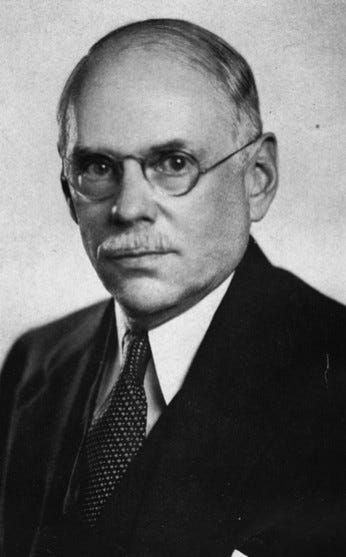
Risk is something you can measure. You do not know the outcome, but you know the odds. A roll of the dice. The chance a part fails on the production line. The odds a customer churns. You cannot say what happens next, but you can put a number on it, price it, and, crucially, insure it.
Uncertainty is the thing you cannot measure. This is the product category that does not exist yet. The competitor not yet founded. The market nobody has tested. You cannot price it, because there is nothing to price it against.
One way to think about it is whether you can insure it. You can buy insurance against your office burning down, because fire is a risk and somewhere there is an actuary with the tables to prove it. You cannot buy insurance against whether the thing you are about to bet the company on will still make sense in five years. That is uncertainty.
What has this got to do with AI?
The reason this matters in the context of your AI investments is threefold.
The first is that profit is the reward that accrues to business leaders and entrepreneurs for bearing uncertainty and exercising judgement in an uncertain business environment.
The second is that AI is eroding the ability of business leaders to exercise judgement in two ways: a false sense of security and a slow atrophy of the judgement ability itself through delegation.
The third, and most important, is that business leaders will soon be confronted with the question of where their competitive advantage will come from when AI becomes commonplace.
Let’s look at each in turn.
1/Profit is the reward for judgement under uncertainty
The decisions that matter for business success sit in that second bucket of uncertainty.
As Knight writes:
The best example of uncertainty is in connection with the exercise of judgment or the formation of those opinions as to the future course of events, which opinions (and not scientific knowledge) actually guide most of our conduct.
And the market rewards a leader’s or entrepreneur’s ability to form good judgements about the future with profit.
Profit arises out of the inherent, absolute unpredictability of things, out of the sheer brute fact that the results of human activity cannot be anticipated….even a probability calculation in regard to them is impossible and meaningless. The receipt of profit in a particular case may be argued to be the result of superior judgment.
2/AI gives false comfort that uncertainty can be eliminated
Machine learning is an engine for measurable randomness. It learns the distribution of the past and projects it forward, and where the future resembles the data it does so with a facility no human can match. In fraud detection, demand forecasting, logistics and the rest of the vast territory of repeatable problems, this is a genuine and growing success, and leaders should take all of it.
Genuine uncertainty, however, offers nothing to learn from. That is precisely what makes it uncertain. The unprecedented event leaves no training data. Asked to forecast it regardless, a model does not decline. It returns a confident figure assembled from the nearest available history. The hazard is that the machine offers a false sense of safety.
Let me take you into a meeting from my Accenture days.
I am working on a trends project where we are quantifying different types of trends, from economic to geopolitical. The aim is to project them into the future so we can estimate the impact on the client’s business.
When my team and I present the findings we present the data for the established trends and we also present some for which there is no data yet, but we believe we should have on our radar. Voice based agents is one of the trends, based on our reading of innovations in the space.
The question we get is: “what about the data for these ones?” I explain there is no data because by definition they are so nascent that there has not been enough time yet to build a robust time series - and this makes it difficult to extrapolate into the future.
“We cannot use it if there is no data behind it” is the response. Data provides certainty and without it the insight was not considered robust enough to inform decision making.
The choice was made: the comfort of a number won over the value of judgement.
Knight, 100 years ago, writing about the booming market for information that uncertainty creates, put it thus: “From this point of view it is not material whether the ‘information’ is false or true, or whether it is merely hypnotic suggestion.”
Today AI vendors are making similarly hypnotic suggestions, promising business executives release from the need to make decisions under uncertainty - the very thing that is demanded of leadership.
3/When everyone has AI, profit will come from the very ability being undermined: judgement under uncertainty
Last week I spoke on a panel hosted at Canva with the title “AI, Humans and the Future of Financial Services”. One of the questions that emerged is one we need to spend more time discussing: “where does advantage come from when everyone has the same tools?”
Knight’s answer was that it cannot come from risk. Anything measurable can in principle be calculated by everyone, hedged, insured and competed away, until the return on it falls towards nothing. Real profit, the surplus that builds a firm beyond sustenance, is the reward for bearing uncertainty: for exercising judgement where no number exists, and being proved right by an outcome that no one could have demonstrated or calculated in advance.
As AI becomes more sophisticated, everything in the measurable bucket is becoming a commodity. If your AI model can compute it, so can your competitor's; the forecast, the score, the optimisation formula, all converge on the same answer for everyone, and the advantage that once lived there is competed away, exactly as Knight would have predicted.
What remains scarce, and therefore valuable, is judgement under genuine uncertainty: the bet on a future that has not happened, the call that cannot be delegated to a data point. If AI commoditises the measurable, the returns migrate to the unmeasurable. So, in time, will the power. This is also a distributional matter, for the people and firms able to exercise such judgement will capture a rising share of the rewards, and the distance between them and everyone else will grow. This emerging inequality is one of the aspects that I explore in my forthcoming book AI-Q and I can on leaders to address. One for a future essay here perhaps.
Three ways business leaders can respond
None of this is an argument against AI. It is an argument for being deliberate about where your judgement stays. One of the things I discovered during my research was that high AI-Q leaders are not the biggest users of AI tools (looking at you token maxers!), but they are definitely the most intentional.
With this in mind, here are three places to start.
1.Know which bucket you are in.
Distinguish the two buckets before acting on any machine output. Where the question is one of measurable risk, trust that the model can offer useful information and move quickly. Where it is one of genuine uncertainty, treat the output as the beginning of a judgement and never as a replacement for one. Mistaking uncertainty for risk can lead to a false sense of safety.
2. Build to survive being wrong rather than to be right.
Under genuine uncertainty, optimising for the forecast is optimising for a guess. The sounder objective to consider is robustness: more than one route to success, options held open, exposure that can absorb a surprise. Resilience beats prediction whenever the future is uncertain.
3.Prepare people now.
As value and power concentrate around those who can act well without a number to hide behind, the central task of leadership is to widen that capacity. The gap between leaders and their employees that can still exercise judgement under uncertainty and those that have handed it over to an AI model, is the gap that will decide who prospers. Buying more technology doesn’t close the gap.
My findings show that it closes by bolstering your foresight mindset, your strategic thinking capabilities and designing your own red lines around the decisions you will never hand to AI.
Uncertainty is good for business
Let’s do a quick thought experiment.
Imagine for a moment that AI delivers on the promise. Every outcome measurable, every business decision reducible to a calculation. It sounds like paradise for business. But wait. If everything could be calculated, everything would be, by everyone. Every opportunity would be priced, hedged and competed away to nothing, and margins would collapse until business was a utility. Profit exists because the future is unknowable. Remove the uncertainty and you remove the opportunity for profit. That is the sense in which uncertainty is good for business. Or as I said earlier on, good for those able to embrace it.
We have been sold a story that the whole point of AI is to take the uncertainty out of business. I think that story has it backwards. AI is going to commoditise the risks, the measurable, and there is real value and benefit to that. It can mean a better understanding of risk and the opportunity to insure against these risks, offering business a way to take on new ventures.
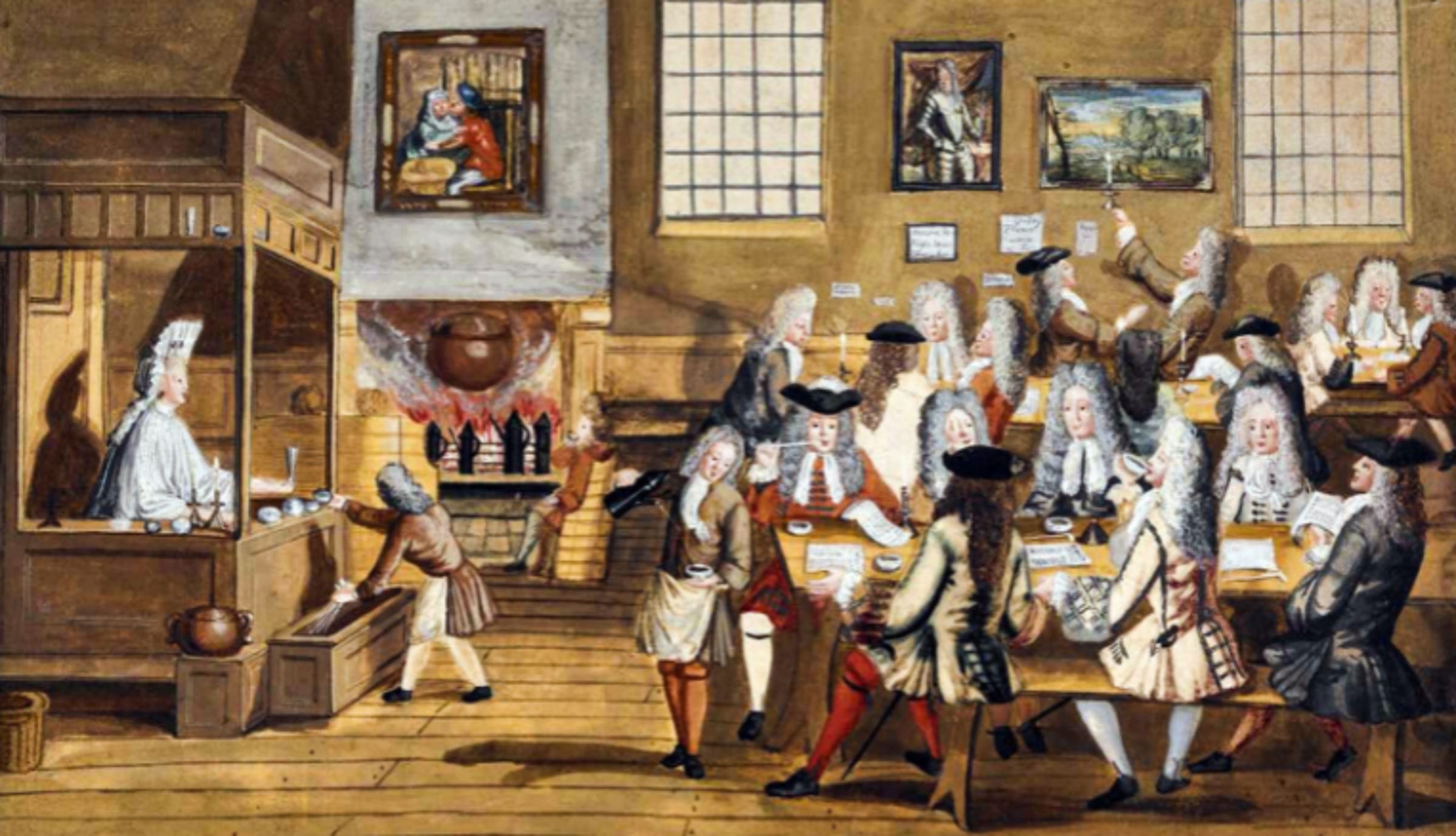
Something similar happened once before. In the 1700s, merchants gathered at Edward Lloyd's coffee house in London to share shipping news and sell each other slices of the risk of a voyage, writing their names under each share which is where the word underwriting comes from. This enabled them to pool information and pool exposure, and brought about a maritime explosion. Once ship owners had split out the risk, they were able to take on more uncertainty: new routes, new cargoes, new markets.
But it also means the measurable is no longer where a business plays to win.
What is left, the part AI cannot yet help us with, is the oldest and most human part of the job of leadership: the judgement to act when no number can tell you what to do. The necessity of acting upon opinion rather than knowledge.
Frank Knight understood this in 1921. How are you protecting that judgement?