

If you’re leading a business right now, your conversations about AI probably look quite different from the ones you were having a year or two ago.
In my conversations one year ago leaders were still asking about the use cases, the potential for their industry, their competitor’s moves, how to get their people to use it.
Now the questions are different.
Most assume that everyone is doing something with AI. But what many are less willing to admit publicly is that not much seems to have changed. All this £ into AI tools and everything still feels kind of the same. After all this hype and promises of transformational impact but the new reality does not seem to match the promises, at least not yet.
That gap between investment and impact is one of the reasons I developed AI-Q.
What is AI-Q?
I define AI-Q as a leader’s capability to create value in a world where human and machine intelligence work together.
It looks beyond familiarity with AI tools to the Mindsets, Abilities and Practices leaders need to decide where AI can create value, how it should be used and how their own leadership needs to change.
AI literacy is important, but it is not the same thing as AI-Q. Knowing what AI can do, or how to use a particular tool, does not necessarily prepare you to make the strategic, organisational and human decisions that follow. And these are becoming much harder questions than simply deciding whether and where AI fits into your business.
Take one example from my research.
John is a partner in a law firm, specialising in space and satellite technology. In one of our discussions he explained how lawyers typically conduct real estate surveys for their clients. This is work that would take a paralegal or junior lawyer two or three days. With AI tools, they are now able to create that survey output “in a matter of hours”.
Initially this looks like a straightforward productivity gain. Faster output and a satisfied client. But it completely breaks down the legal firm’s pricing model.
I found that the legal profession is a particularly interesting case because they charge in six-minute increments. Their earning potential is directly tied to time: an input, not an output.
The same applies to other professional services such as consulting, a sector where I spent nearly 15 years with Accenture. In a world where AI models speed up tasks, and clients expect you to use those tools - or your competitors are, and therefore they change the logic of competition- what does that mean for the way you create revenue?
You have gained productivity. But you may also have undermined the economics on which the existing business model was built.
This is why AI leadership must go beyond AI adoption or AI literacy.
Leaders are being asked to answer strategic questions like this one, while still working out what AI means for their own jobs and confronting more personal questions:
If AI can analyse, write, code and advise, what does that do to the value of my own expertise?
That tension sat at the heart of a lot of the conversations I had during my research.
We talk about companies adapting their business models, organizations becoming more agile, work being redesigned. But companies, organisations and work are abstract entities.
And abstract entities do not drive change.
People have to make those changes happen. That is you and me. And over time, I realised that the core question worth investigating was different to the one I started with.
The question became: How ready are leaders themselves for AI?
And that is the starting point for AI-Q.
Why do leaders need a new capability for the human + AI era?
Management theory, leadership language and organizational practices evolve in response to the economic and social challenges of the era.
In the late 1990s, as many developed economies shifted from manufacturing to service-based sectors, new ideas about management and leadership emerged. Work became less about operating machinery and more about interacting with other people, so organizations needed different ways to think about performance and success at work. Daniel Goleman’s work on Emotional Quotient (EQ) captured that shift. It gave leaders new language for what good looked like in a relationship-driven economy.
In the 2000s another shift followed. As climate risk and social responsibility moved from the margins to the mainstream, new ideas emerged again. Corporate Social Responsibility, and later ESG, provided leaders with new concepts and measures to respond to new pressures around environmental and social expectations.
Today, we are at a similar turning point.
AI creates leadership challenges that even people with decades of experience have not encountered before.
Think of AI agents. They are not ‘employees’ in the traditional sense, so do not carry accountability in the way that you do. Yet their actions increasingly shape decisions and outcomes for your business. This increases your exposure as a leader. One of the companies I advise is BossUp.AI, a startup pioneering AI readiness metrics. The co-founder and CEO Rahan Arif quipped during one of our conversations: “You can delegate authority but not accountability”. That distinction becomes important very quickly. Imagine an AI agent goes rogue and makes a costly mistake. You still own the consequences and the explanation to the board, and potentially regulators, for something you don’t fully understand. AI blurs responsibility in ways previous automation did not.
Despite these major shifts in what is required of leaders, our thinking remains stuck in outdated assumptions. We are using old maps to navigate a new terrain.
This is why I believe we need new leadership approaches built around the new set of questions emerging:
How can you measure the ROI of AI investment?
How do you make decisions when you do not have the complete picture?
How do you remain accountable for decisions increasingly shaped by machines?
How can you lead when leadership is no longer about having all the answers?
AI-Q: a new way to lead
This is what AI-Q is all about: a new way to lead in the human + AI era.
I surveyed 200 senior decision makers, reviewed more than 150 studies and articles, and had in depth conversations with more than 50 leaders across different sectors and functions.
What I found is that our conversation on AI readiness, was that it looks primarily at employees.
Are they using the tools we’re paying for? Have they had enough training? Are they experimenting? Do they have the right skills? And increasingly, how do we allocate our token budget?
All of them fair questions. But who is asking the equivalent questions of the people leading them? Are they adapting their own leadership as human and machine intelligence become increasingly intertwined?
This is why in the book I address the lack of ROI problem at its most fundamental level: how ready leaders themselves are to manage hybrid human and AI teams.
That is a very human part of the AI story, and I think we talk about it too little.
None of this means leaders need to become AI experts.
But they do need a different kind of readiness.
The good news as I discovered during my work is that these patterns of leadership are not fixed and can be developed through consistent effort. That is where the AI-Q framework comes in.
What are the three dimensions of AI-Q?
It has three dimensions that reinforce each other: Mindsets, Abilities and Practices (MAP).
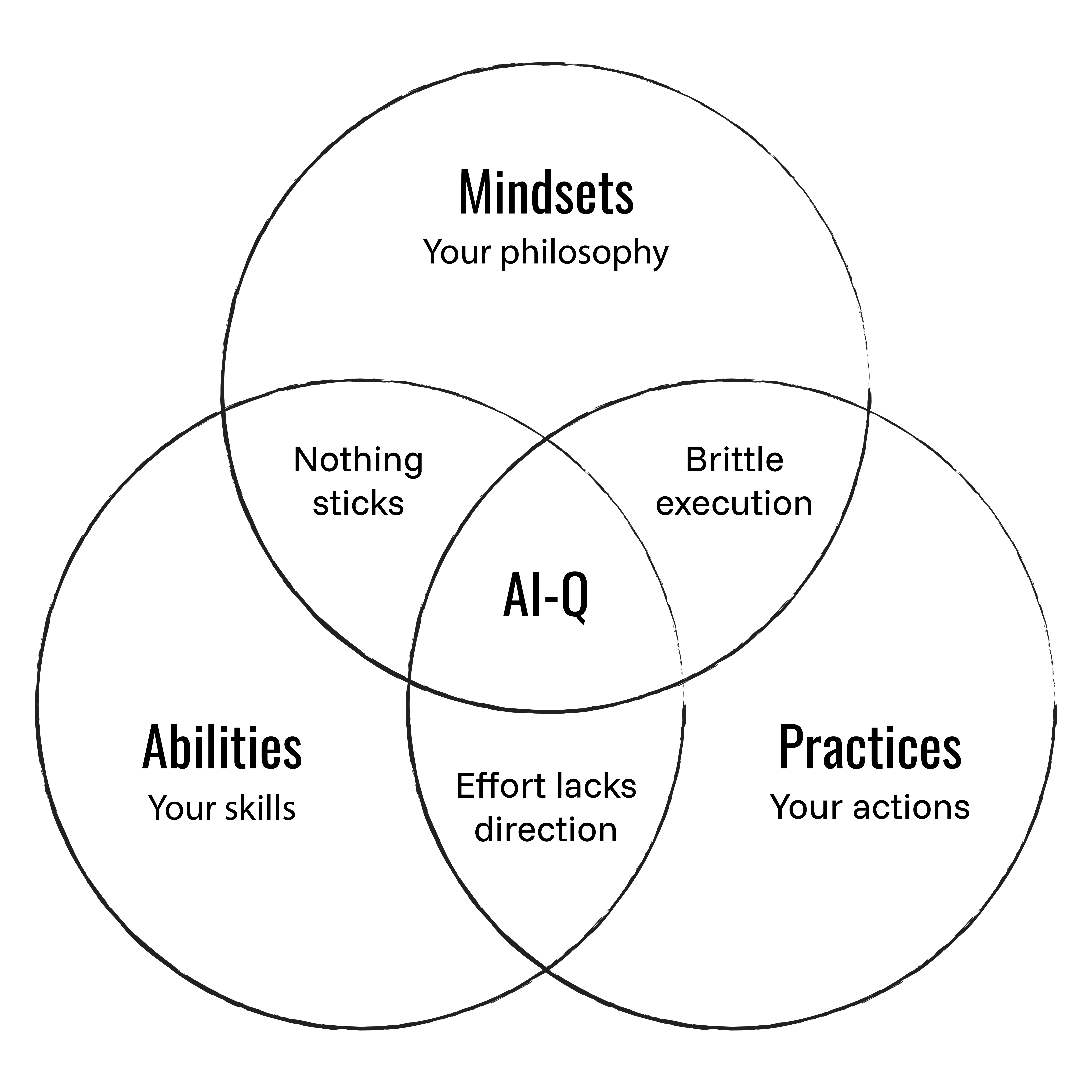
Mindsets
Mindsets refer to how you think about AI and your role as a leader in relation to it.
They include your beliefs, even those unspoken, that shape how you engage with the technology. Together they shape how fully you bring your leadership capabilities to bear.
High AI-Q leaders
Continue learning about AI for themselves.
See AI as part of an interconnected system rather than as an isolated tool.
Think ahead to where the technology may be taking their organisation and industry.
These mindsets shape what you notice, the questions you ask and ultimately the choices you make.
Abilities
Abilities are the human capabilities that enable you to lead effectively alongside AI.
Across my work, the same five abilities came up as differentiators of high AI-Q leaders: critical thinking, empathy, strategic thinking, creativity, and learning agility.
You will notice that these abilities are not that new.
What changes is that the context in which we use them in a human+AI workplace - while also making them scarcer therefore more valuable.
Critical thinking becomes increasingly important when an AI can produce a convincing answer instantly.
Empathy matters when people are trying to understand what AI means for their identity, expertise and jobs.
Strategic thinking and creativity help leaders look beyond simply automating what already exists.
And learning agility matters when whatever you know about AI today is unlikely to be sufficient for long.
These abilities are deeply human. In that sense, they are both timeless and timely.
But how do you make all of this stick?
Practices
Practices are the concrete actions through which mindsets and abilities show up in your approach to AI.
They are the ways of working that turn AI-Q into everyday leadership.
In my research, five practices stood out:
Start with the problem. Are you clear about the problem you are trying to solve before reaching for AI?
Define your red lines. Have you decided where your non negotiables are?
Run intentional experiments. Are your experiments designed to create learning not just activity?
Measure outcomes. Are you measuring value and results, or simply usage?
Build learning bridges. Are you creating ways to share lessons and build capability across teams and leaders?
Without practices, good intentions remain intentions.
Together, these three, Mindsets, Abilities and Practices, provide a snapshot of where you are today, and a roadmap for leading better tomorrow. And because AI-Q can be made visible and measurable, leaders can move beyond a vague sense of whether they are “ready for AI” and make more deliberate choices about what they need to develop next.
Do you know your AI-Q?
There is more guidance in the book, but you can start with three fairly simple questions.
Have you made a specific decision in the last year that was based on where you believe AI will be in three to five years, not where it is today?
Do you have a reliable way of telling when an AI output is wrong, biased, or incomplete before it reaches a consequential decision?
Can you show concrete measures and evidence of how AI delivered against initial expectations, and what changed as a result?
These questions go beyond whether you understand AI or use it regularly. They start to reveal whether your leadership itself is adapting for the human+AI era.
That is where AI-Q starts.
Over the coming months, I’ll be unpacking the different elements of AI-Q here: what leaders should delegate to AI, which human abilities become more valuable, how to measure AI value and what good AI leadership looks like in practice.
If these are questions you are working through too, subscribe to The Athenian Intelligence for my research and writing on AI, leadership and the economy.
Recently on Athenian Intelligence:


