

Here is a line from a talk I gave recently at a leadership briefing on AI-Q. It was met with stunned silence: ‘To be an AI-ready leader you don’t need to be the person who knows the most about AI, nor the most confident. You don’t even need to be the one with the biggest budget for AI. But you do need to be the one adapting how you lead.’
There was discomfort. Most of our conversation until then had focused on employees. Are they using the tools we’re paying for? Have they had enough training? What is their token usage? All of them important questions. What I intended with my statement was to reframe their focus and say, well, who is asking the equivalent questions of the people leading them?
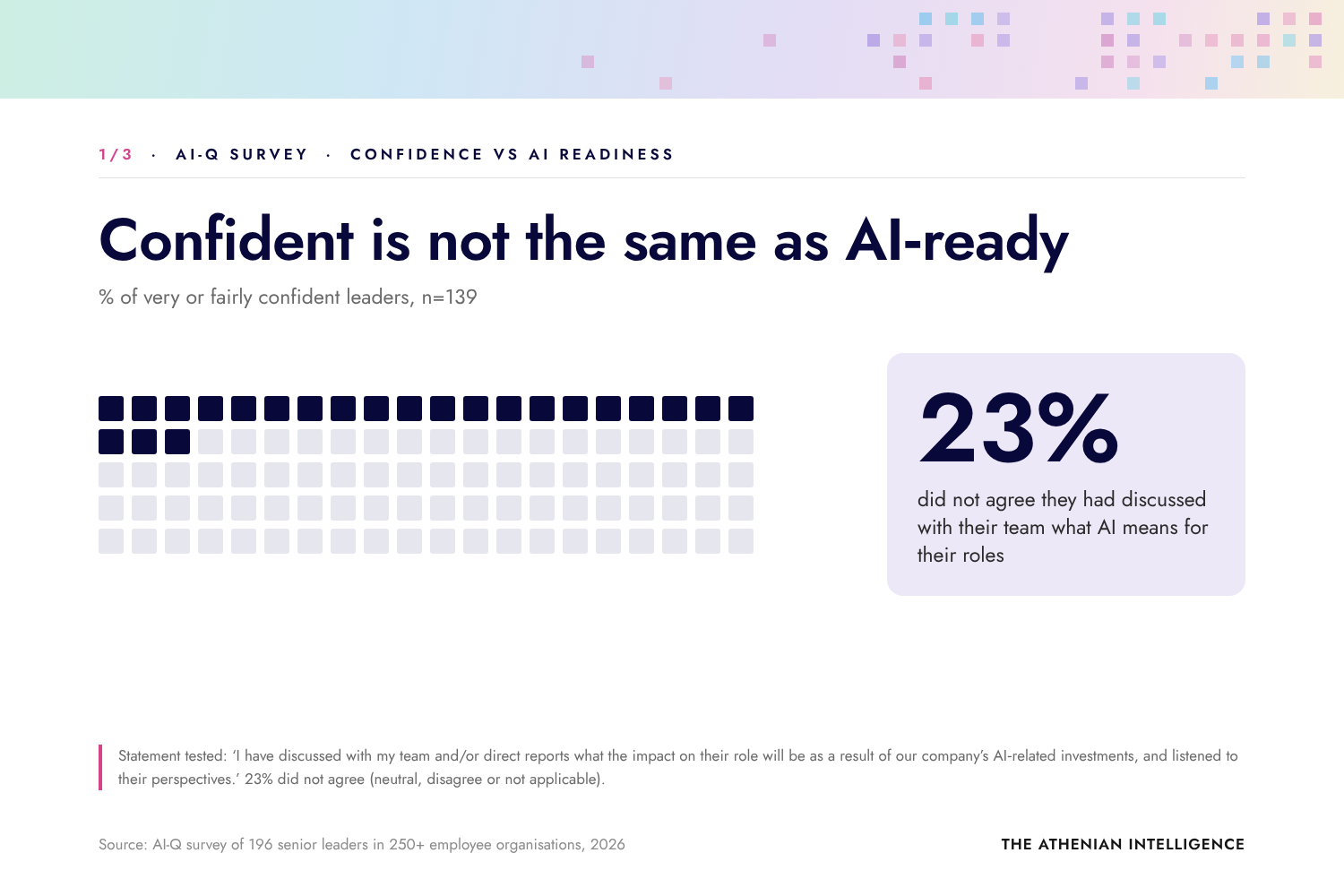
When I surveyed nearly 200 senior leaders for my book AI-Q1, almost a quarter of those who described themselves as confident leading their teams through AI changes also stated that they had not yet had a conversation with their teams about that change. Confidence, clearly, is not the same as readiness.
So today I want to discuss this important question: what makes a leader AI-ready? And to get started I want to first explore 1/ what AI readiness means, 2/ what could be holding some leaders back in their journey towards AI readiness, and 3/ what needs to change.
What makes a leader AI-ready?
Put simply, an AI-ready leader is one who adapts how they lead, and goes beyond focusing on the tools their teams use. Across my research, the leaders getting results from AI were not the biggest users of AI tools, nor the ones with the biggest budgets. They were the most intentional about adapting their own leadership. Three things in particular set them apart:
How they think about AI. They see AI as something that changes their role as a leader, not just their team’s toolkit.
How they work with it. They rely on the human abilities that matter more as AI does more: critical thinking, empathy, strategic thinking, creativity and learning agility.
What they do differently. They turn intent into concrete, everyday ways of working, rather than leaving AI to training programmes and tool rollouts.
In my research I call this AI-Q: a leader’s capability to create value in a world where human and machine intelligence work together. It is built on three dimensions, Mindsets, Abilities and Practices, and it is the overlap between them that counts. If mindset shapes how you think about AI, and abilities shape how you work with it, practices shape what you do. Leaders with a high AI-Q were three times as likely to report a quantified business outcome from AI.
So if we know broadly what AI-ready leadership looks like, why aren’t more leaders adapting? Several barriers get in the way.
What are the barriers to leaders adapting to AI?
1. The experience trap
Richard Chiumento, Director at Rialto Consultancy, has spent decades advising senior executives through career transitions. When I spoke to him about what he is seeing in his work with leaders navigating the AI era, he shared a troubling pattern. ‘Leaders are using a traditional, obsolete playbook’, he explained. ‘They think: I’m an experienced senior person. I’ve been successful. My domain expertise will help me continue to succeed. But the old playbook doesn’t work anymore.’
This is the experience trap: that the very things that got you to a senior position are not the ones that will help you progress with AI. The rapid pace of technological change means skills now have a half-life of about five years, according to IBM research, requiring you to constantly learn to remain relevant.
2. The know-do gap
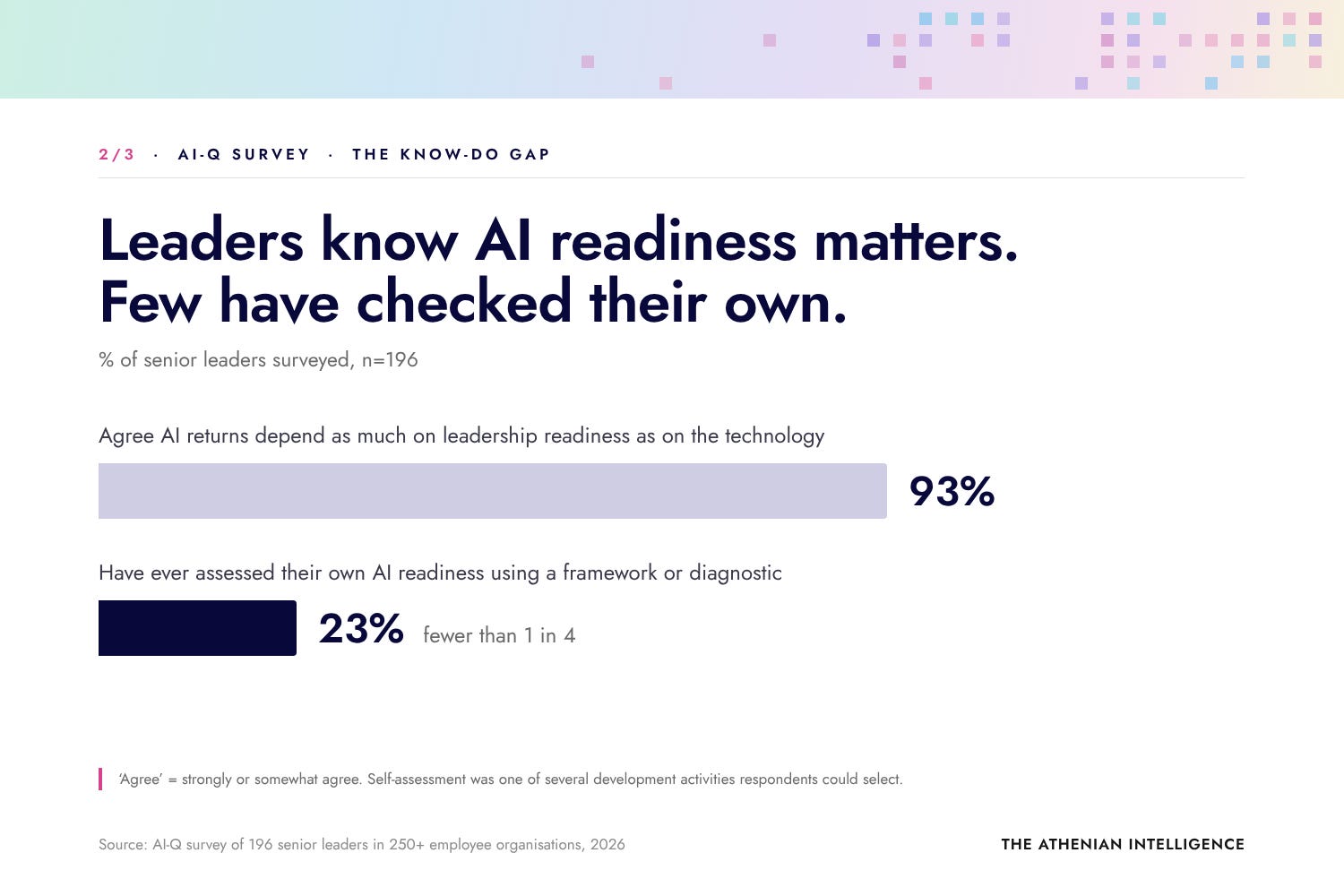
Nine in ten leaders that took the AI-Q survey agree that the return on AI investment depends as much on leadership readiness as on the technology itself. That level of agreement is striking. What they do about it, or don’t do, is even more so.
Before taking the survey, fewer than one in four had ever assessed their own AI readiness in any structured way, one of the least common development activities, behind attending conferences, reading about AI and taking AI courses. This suggests that leaders are not yet tapping into the benefits of the kind of deliberate, structured self-reflection that turns awareness into action.
3. Speed whiplash
The pace of change is so disorienting that standing still until the dust settles appears to be a sensible choice. During the interviews for my book, I spoke with Simon Burton, Managing Director of CB Resourcing, who places senior knowledge workers into consultancies, banks, legal firms and private equity, giving him a rare, cross-sectoral view of how organisations are responding to AI. He put it plainly: ‘Because things are moving so fast, some leaders can feel paralysed by the scale of the task ahead.’ The result, he told me, is often a ‘wait and see’ approach that feels prudent today, but is unhelpful in the long run.
Sometimes that paralysis comes with its own logic. On a separate occasion, a senior director at an insurance firm said in response to my question about their AI readiness: ‘If the agentic future will make roles redundant anyway, why invest in upskilling people who may not be doing the same job?’
The experience trap, the know-do gap and speed whiplash are by no means an exhaustive list. I am certain there are other factors at play and it would be far too crude to assume that these three areas cover every single possibility as to why some leaders have not adapted. However, those three were barriers that kept cropping up in my conversations and stood out in terms of their importance.
What needs to change for leaders to become AI-ready?
Three things need to happen in the public conversation around AI for organisations to start seeing the benefits of their AI investments.
1. Shift from AI literacy to AI readiness
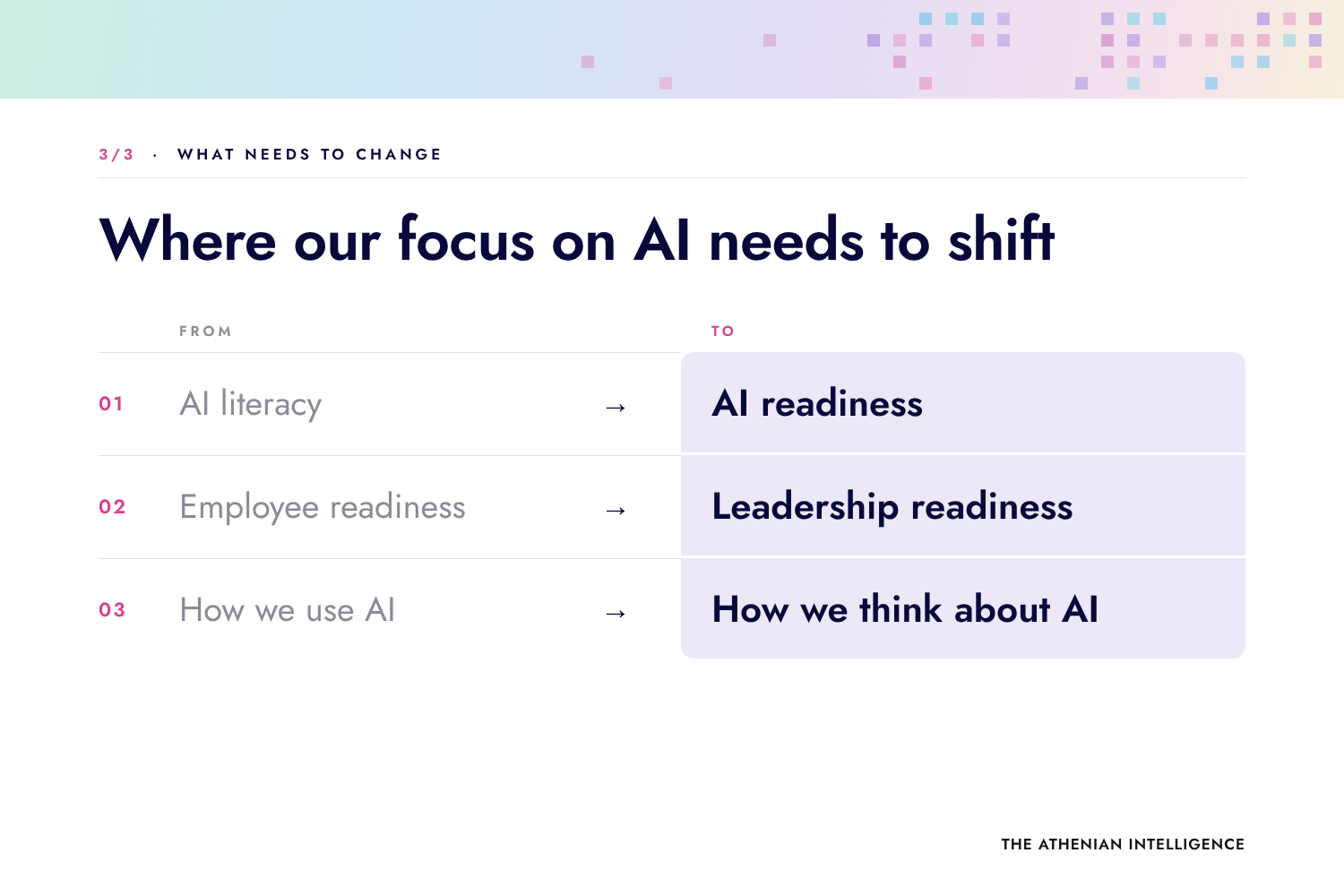
When I was writing about this topic one year ago a lot of the debate focused on literacy and more specifically the technical skills needed to use AI. Guides around how to prompt, what your AI stack is and hacks for how AI can free up hours of your time were dominating and getting a lot of attention. Over time this is moving from ‘How to use AI’ towards ‘How to use AI well’. Readiness goes a step further. It asks not only whether you can use AI well, but whether you are adapting how you lead because of it.
2. Shift from employee readiness to leadership readiness
Individuals make their own choices. Leaders shape those choices for their employees through the way they design processes, set incentives and govern decisions. A key reason that leadership readiness remains underexplored is that we have not yet reframed our existing ways of working for the human + AI era. Yet, to close the AI readiness gap – the growing disconnect between what organisations invest in AI technology and how prepared people are to use it effectively – we need to rethink leadership itself.
3. Shift from the way we use AI to the way we think about AI
In the mad rush to ‘not get left behind’ many leaders and companies invested in AI tools and vendors that promised results. Being an AI sceptic was seen as a curse, a sure way to end up in the corporate junkyard alongside Blockbuster and Toys R Us, overtaken in the digital revolution by Netflix and Amazon. Increasingly I am seeing leaders be more thoughtful about where AI should and should not play a role in their organisation. Indeed two thirds of the leaders I interviewed specifically called out a problem-first approach as the guiding principle for their AI adoption, and railed against the AI-first mentality that still dominates across many firms.
Pandora’s box or panacea? Why leaders need to steer AI
The public debate around AI is pushing us towards two extremes.
On one side, AI is framed as Pandora’s box: a technology that, once opened, will bring irreversible harm, such as mass unemployment, algorithmic bias, concentration of power, existential risk. The solution from this camp is to contain AI, restrict it or, in some cases, outright ban it.
On the other side, AI is presented as a panacea that will solve humanity’s toughest challenges: cure diseases, end poverty, unlock unlimited productivity, democratise expertise. The solution from this camp is speed, deploy it fast and have faith that benefits will outweigh risks.
But we have a third option. We can steer.
AI is neither Pandora’s box nor panacea. The outcome is not predetermined, contrary to what the Silicon Valley gurus would have us believe. In a talk I attended at the Royal Society of Arts, the economist Daniel Susskind argued that using the train as an analogy for AI adoption is misleading, because it suggests the tracks are already laid and you just need to climb aboard.
I agree. The trajectory is not fixed. It is more like a ship in open water. You can be the wise captain who steers around the currents and obstacles you anticipate.
AI is a powerful technology. But it’s the choices you make today about how to prepare yourself and your teams that will shape the outcome of AI. The future is being written now and it needs you to act.
You can start by reframing your own leadership.
What is the biggest barrier you see holding leaders back? Tell me in the comments.
Recently on The Athenian Intelligence:


About the research: the AI-Q survey sampled nearly 200 senior leaders running functions in B2B or B2C organisations with 250 employees or more. Sectors included financial services, professional services, technology, manufacturing, retail and healthcare. Education and media were included but had lower representation.